Top 10 Foreign-Language Horror Movies
Updated: Jun 22
While horror fans have been eating good this year, the offerings have dried up for June’s theatrical releases. But fear not, horror friends, as there is much more to be explored – from the comfort of your own home, no less.
This season of Ormeau Community Cinema celebrates films from across the globe, and it is perhaps more important than ever that we give international voices the platform they deserve. With this in mind, we have comprised a top 10 list of foreign-language horror films for you to enjoy. Gathered from the IMDB Official Rating List (movies 10, 000 views and up), Rotten Tomatoes 200 Best Horror Movies of All Time, and Letterboxd Official Lists: Top 250 Horror Films, we have collated the ratings of a long list of foreign-language horror, worked out the average combined score, and produced a stellar top 10 – that’s science, baby.
So pull the curtains closed, get cosy, and make your way through our top 10 list of foreign-language horror – because what better way to celebrate summer than to sit in a dark room getting spooked? (don’t forget the snacks)
Number 10: Kwaidan (Japanese – 1964 - Masaki Kobayashi) – 84.33

7.9 IMDB / 4.2 Letterboxd / 91% Rotten Tomatoes
A Japanese horror anthology film consisting of four separate stories adapted from Japanese folktales. Escalating production costs meant it became one of the most expensive Japanese films of its time, and its lower earnings at the box office resulted in a substantial financial loss and subsequent bankruptcy of the production company. Despite a disappointing release, it went on to win the Special Jury Prize at the 1965 Cannes Film Festival, and received an Oscar nomination for Best Foreign Language Film in 1966. It has since been credited with establishing the long black-haired ghost visual as a recurring motif in contemporary J-horror cinema, so we can thank it for our ‘The Ring’ induced childhood trauma.
Joint Number 8: Cure (Japanese – 1997 - Kiyoshi Kurosawa) – 85.00

7.5 IMDB / 4.3 Letterboxd / 94% Rotten Tomatoes
A 1997 psychological horror following a detective’s investigation into a series of murders whose perpetrators are seemingly being driven to kill by an unknown force. Since its release, it has been deemed influential on the late 1990s wave of Japanese horror cinema and praised for subverting the serial killer genre at a time where Western psychological horrors were prevalent. The film has been listed as one of ‘Parasite’ director Bong Joon-ho's top 10 favourite movies, and praised by Ari Aster who stated ‘there’s a good case to be made that Cure is the best movie ever made.’ Martin Scorsese also has high praise for its light, framing and pacing that creates moments ‘when the slightest gesture in the corner of the frame will send a shiver down your spine.’
Joint Number 8: The Cremator (Czechoslovak – 1969 - Juraj Herz) – 85.00

8 IMDB / 4.3 Letterboxd / 89% Rotten Tomatoes
A horror comedy set in 1930s Prague, following a demented cremator who believes death is the only relief from human suffering. After a visit from an Austrian friend, his worldview is altered to incorporate the ideology of the Third Reich, and a descent into madness ensues as he formulates his own final solution. It is an expressionist blend of dark comedy, horror and socio-political satire that uses extreme close-ups, disorientating shots and distorting lenses to create what is now classed as a Czech New Wave masterpiece. Due to its dark exploration of totalitarianism, ideology and Nazism, it was banned upon its release and withdrawn from circulation in 1973, hidden away until the collapse of the communist system in Czechoslovakia in 1989.
Joint Number 5: Let the Right One In (Swedish – 2008 - Tomas Alfredson) – 85.33

7.8 IMDB / 4 Letterboxd / 98% Rotten Tomatoes
An adaptation of the 2004 vampire novel, it tells the story of a 12-year-old boy out for revenge on his bullies, and the relationship he builds with a strange girl who offers her help. It was nominated for a BAFTA for Best Film Not in the English Language in 2010, and received an American remake released in 2010 under the title ‘Let Me In’, starring Chloë Grace Moretz. The film is praised for its blending of the horror genre with a poignant coming of age story, classing it as one of the best modern vampire movies.
Joint Number 5: The Cabinet of Dr Caligari (German – 1920 - Robert Wiene) – 85.33
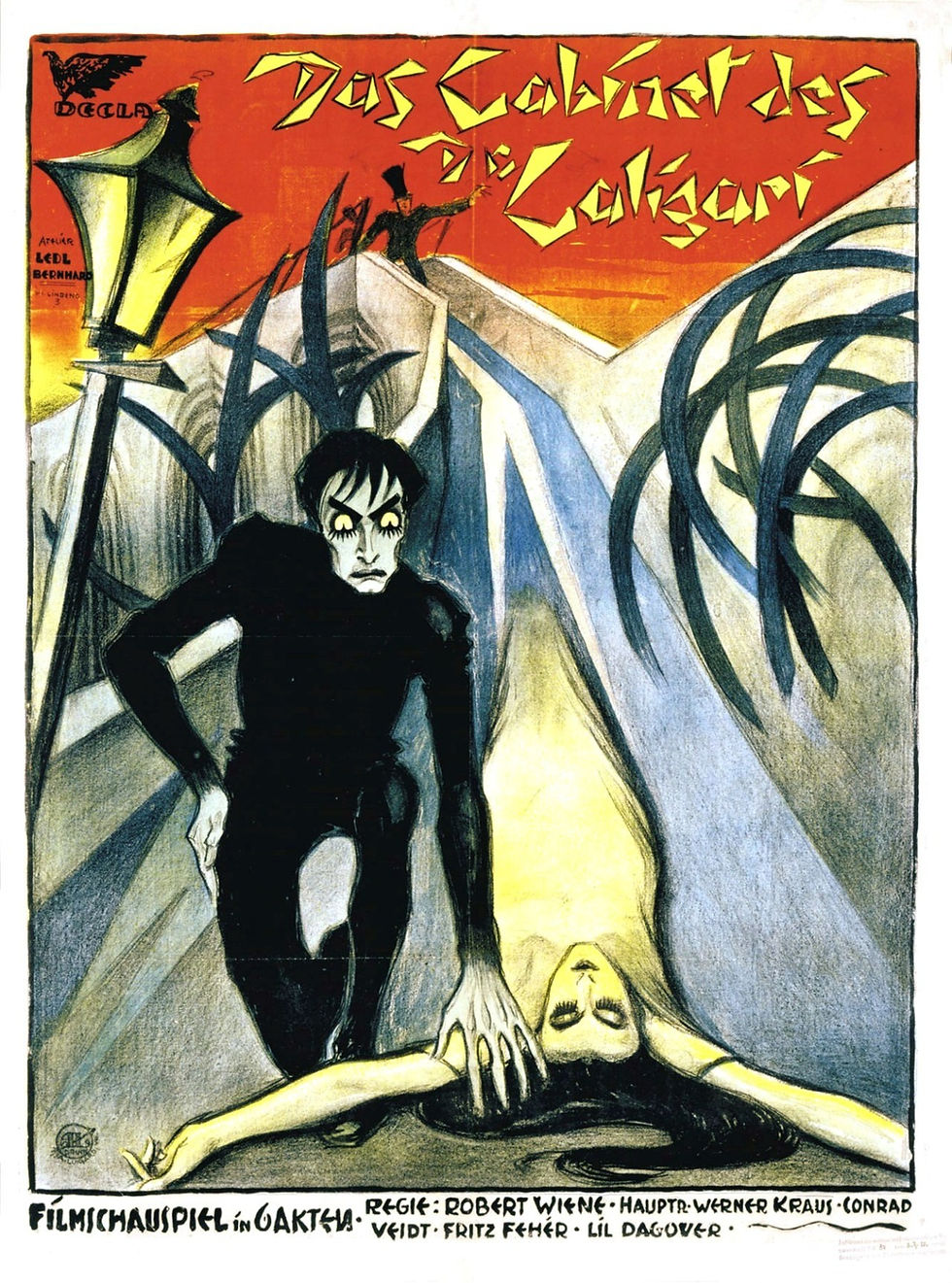
8 IMDB / 4.1 Letterboxd / 96% Rotten Tomatoes
Argued as ‘the first true horror film’ by Roger Ebert, 100 years on it remains a landmark of silent cinema and a trailblazer of German Expressionism. Its twisted visual style of contorted angles and sharp jagged edges, and an unreliable, psychological narrative, was radical for its time, and became hugely innovative and influential in the development of filmmaking and film noir. It follows a student in a small German town whose friend was murdered by a sleep-walker under the control of Caligari – a local fairground entertainer and hypnotist. Given the film’s influence on the genre, it is no surprise it has been cited as a major reference for movies like Suspiria (1977), and directors like Tim Burton, with clear visual homages in the latter’s work.
Joint Number 5: One Cut of the Dead (Japanese – 2017 - Shin'ichirō Ueda) – 85.33

7.6 IMDB / 4.1 Letterboxd / 100% Rotten Tomatoes
An independent satirical horror comedy based primarily on the stage play ‘Ghost in the Box!’ The ultimate meta-movie, the first act depicts a film within a film as it follows a film (say film again) crew tasked with making a one-take zombie horror for live television. The second act then shifts gears to show the making of the movie behind the scenes. Made on a low $25, 000 budget, it opened in a small cinema in Japan on a six-day run before making box office history upon its worldwide release, earning over 1000 times its budget. Rotten Tomatoes have since ranked it #1 in their list of 100 Best Found Footage Movies, and as of July 2025 it was the only found footage film to have received a 100% rating on their site.
Joint number 3: Faust (German – 1926 - F. W. Murnau) – 86.67

8.1 IMDB / 4.1 Letterboxd / 91% Rotten Tomatoes
A silent film that draws on the legendary German moral tale of Faust, about a scholar who sells his soul to the devil. It was directed by Friedrich Wilhelm Murnau – one of cinema’s most influential filmmakers for his work in the silent era, and also responsible for the iconic Nosferatu (1922). Prior to the film, the legend of Fauste had been adapted into a two-volume play that was much beloved by the German population. Given the liberties Murnau took with his film adaptation, it received overwhelmingly negative reviews upon its release. However, over time, Murnau’s Faust has become a landmark in early cinematic illusion, due to it groundbreaking practical effects.
Joint Number 3: Les Diaboliques (French – 1955 - Henri-Georges Clouzot) – 86.67

8.1 IMDB / 4.2 Letterboxd / 95% Rotten Tomatoes
Les Diaboliques is a French noir psychological horror based on the 1952 novel ‘The One Who Has No More’, following the revenge murder plot of a wife and a mistress in a boarding school in Paris. The cinematic lore runs deep with this one, with director Henri-Georges Clouzot beating Alfred Hitchcock to the screenplay rights to the novel – supposedly only by mere hours. While there is little evidence by way of the actual time between the two fighting for the rights, the impact Les Diaboliques subsequently had on Hitchcock is undeniable. Robert Bloch, the author of ‘Psycho’, stated Les Diaboliques was his all-time favourite horror film, and Hitchcock supposedly played it to his film crew while making the film adaptation of Bloch’s novel. Perhaps unsurprisingly, both films feature famous bathroom sequences and shocking plot twists that have since went down in film history. For Les Diaboliques, it is a plot twist so shocking it was deemed Stephen King’s ‘single scariest moment I have ever had in entertainment.’
Number 2: Demons (Japanese – 1971 - Toshio Matsumoto) – 87.00

7.9 IMDB / 4.2 Letterboxd / 97% Rotten Tomatoes
Deemed ‘the darkest samurai film ever made’ by Roger Ebert, the film is also known by titles ‘Shura’, ‘Pandemonium’ and ‘Bloodshed.’ It is described as avant-garde, with jarring, repetitive edits used to depict a ronin’s (a masterless samurai) descent into madness after he is betrayed by a woman he loved. An opening shot of an orange sun acts as the only colour in the entire movie, shifting the remainder to black-and-white as it sets on the horizon. It is based on a kabuki play by Tsuruya Nanboku – the author of Japan’s most famous ghost story that shaped the iconic yurei image behind J-horror classics like ‘Ringu’.
Number 1: The Phantom Carriage (Swedish – 1921 - Victor Sjöström) – 87.33

8 IMDB / 4.1/5 Letterboxd / 100% Rotten Tomatoes
A Swedish silent film based on the 1912 novel ‘Thy Soul Shall Bear Witness!’, it follows a drunk man forced to reflect on his life by the ghostly driver of Death’s carriage on New Year’s Eve. It was released in the United States under the title ‘The Stroke of Midnight’, and under the book’s title in the United Kingdom. It has since been listed as one of the titles in ‘1001 Movies You Must See Before You Die’, for its influence not only on Swedish cinema, but on many directors and producers, including Ingmar Bergman and Robert Eggers. It also inspired the iconic axe scene from ‘The Shining’ so we should give credit where it is most certainly due. Johnny and his axe thanks you for your service, Victor.


Comments